The search for a “guided selling tool” usually ends in the wrong place
Shops searching for a guided selling tool want something real: a way to help customers navigate a complex product catalog without handing them a filter panel and walking away. The phrase comes from B2B sales (Salesforce, SAP, Zoho use it for CPQ workflows), so most results point to enterprise sales automation, not e-commerce.
What beauty and personal care stores actually need is an AI beauty advisor. The goal is the same, but the mechanism is different. Instead of scripted logic trees, an AI beauty advisor holds a free-form conversation with the shopper, asks qualifying questions, and recommends products based on their specific situation. Most stores evaluating this category encounter the same common pitfalls first.
What doesn’t work for beauty stores
Most stores try one of three approaches before realizing none of them work well. The shared problem: they all assume customers know what they want.
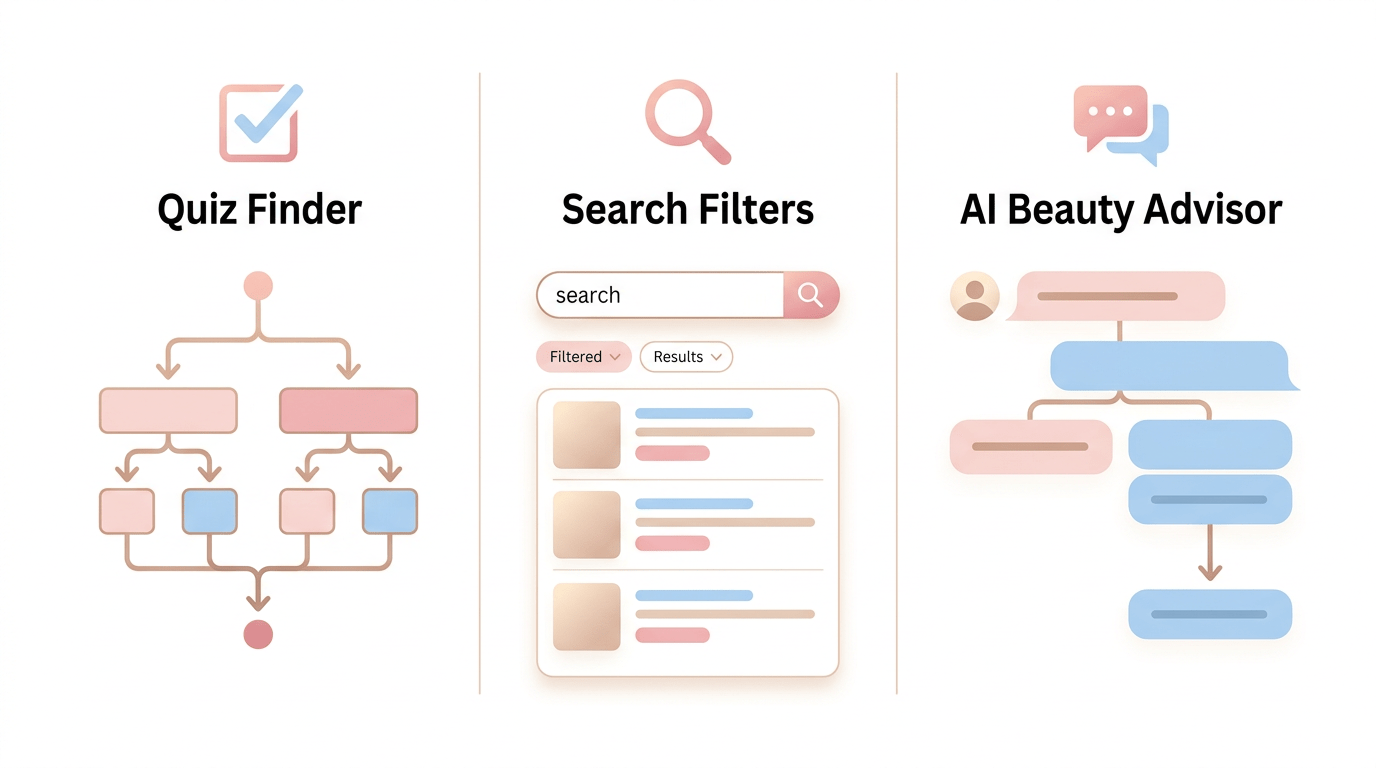
Quiz-based product finders. These feel interactive, but the outcomes are pre-scripted. The quiz routes shoppers to a fixed list based on their answers. A customer combining products from two brands, or avoiding certain actives for health reasons, gets a recommendation that ignores those constraints. The quiz cannot ask a follow-up question.
Keyword-matching search. Standard e-commerce search matches words, not needs. A shopper who types “something for damaged hair after bleaching” gets zero results or irrelevant ones. Our AI beauty advisor reads the intent, then asks: how damaged, what treatments have they tried, what does the current condition look like.
Recommendation engines built on purchase history. These are useful for upsell and cross-sell, but they do not help new customers or shoppers who want guidance before a first purchase. They reflect what other people chose after already making a decision. A shopper who has not decided yet gets no useful signal from that data.
All three require the shopper to already understand the catalog. An AI beauty advisor starts from the shopper’s situation, not the catalog.
What to look for in a guided selling tool
Not all tools are equal.
 These four criteria determine whether the tool will actually work for your store, or just look convincing in a vendor demo.
Catalog coverage. Can the tool answer questions about any product in your catalog, or only the ones you have manually configured? Pre-loaded Q&A pairs do not scale. Look for AI that is trained on the full catalog, including ingredient lists, usage instructions, and compatibility notes.
Conversation depth. Does the tool hold multi-turn context, or does it give a recommendation on the first query and stop? A hair care consultation often takes four or five exchanges: hair type, hair concern, scalp sensitivity, styling habits, budget. Single-turn tools give generic recommendations regardless of what the shopper actually needs.
Language coverage. If your store serves more than one market, the tool should conduct the full consultation in each language natively. A tool that routes everything through a translation layer often loses nuance in beauty and ingredient terminology.
Integration and maintenance. How long does setup take, and what happens when the catalog changes? A tool that requires manual updates every time you add a product is an ongoing maintenance burden. Catalog sync should be automatic.
Search filters, quizzes, and AI beauty advisors compared
| Search Filters | Quiz Finder | AI Beauty Advisor | |
|---|---|---|---|
| Multi-constraint queries | No | Partially | Yes |
| Multi-turn conversation | No | No | Yes |
| Handles unusual situations | No | No | Yes |
| Works for first-time buyers | No | Partially | Yes |
| Language coverage | Limited | Limited | Multi-language |
| Catalog sync | Automatic | Manual | Automatic |
The pattern is consistent: tools built on static rules handle known scenarios well but break on anything outside their decision tree. An AI beauty advisor handles edge cases because it reasons about the question rather than matching it to a template.
What this looks like in practice
At OmniAdvisor, we have processed over 200,000 beauty conversations since June 2024. The most common pattern is not a shopper asking for a specific product. It is a shopper describing a problem. Hair color-treated three times in six months. Skin that reacts to fragrances. A budget under 30 euros for a complete routine.
The AI beauty advisor conducts a conversational consultation. It identifies the skin type or hair condition through dialogue, checks ingredient compatibility, and builds a recommendation that fits the shopper’s actual situation. A shopper already using retinol gets different guidance than one who has never built a routine before. Among shoppers who engage with these consultations, conversion runs 3-5x higher than among those who browse without assistance.
That is what “guided selling” looks like when it is built for e-commerce, not B2B sales pipelines.
For more on how conversational guidance differs from traditional approaches, see our overview of conversational commerce or the AI beauty advisor page.
Book a demo to see the AI beauty advisor working with real products, or start a free trial to add it to your store.