“Customers Also Bought” Is Not Personalization
Personalization for beauty ecommerce usually means a widget. “Customers who viewed this also bought…” followed by a grid of products that other people purchased. It feels like a personalized beauty shopping experience, but it’s not.
Two shoppers can both search for “hyaluronic acid serum.” One has dry skin and wants deep hydration. The other has dull, dehydrated skin and actually needs a brightening product, not just more moisture.
A recommendation engine that looks at purchase history will show both shoppers the same bestselling serums. It can’t know that one of them needs something entirely different.
In beauty, the difference between a good recommendation and a wrong one is the difference between a repeat customer and a return, and a returned open product cannot be restocked. It goes straight in the trash.
Most beauty retailers treat personalization as a problem already solved. They install a recommendation widget, connect it to their catalog, and move on. The result is a system that mirrors the crowd back at the individual, which is popularity, not personalization.
Four Levels of Personalization
| Level | Method | Limitation |
|---|---|---|
| Popularity-based | “Customers also bought”, bestsellers | Ignores the individual entirely |
| Segmented | Demographics, purchase history | Same group = same recommendation |
| Conversational | AI asks questions, adapts in real time | Requires dialogue (not passive) |
| Predictive | Anticipates needs from context + history | Still emerging |
Not all personalization is equal. There is a spectrum, and most e-commerce stores are stuck near the bottom of it.
At the basic end, you have popularity-based recommendations: “customers also bought,” bestseller lists, trending products. This works for commodities, but it fails in beauty because it ignores the individual entirely.
One step up is segmented personalization, where customers are grouped by demographics, purchase history, or browsing behavior. “Women aged 25-34 who bought anti-aging products.” Better, but a 30-year-old with sensitive skin and a 30-year-old with oily skin still get the same anti-aging recommendations.
Conversational personalization is where the experience fundamentally changes. The AI asks questions, listens to answers, and changes its recommendations based on what the shopper reveals in real time.
The shopper says “I have sensitive skin,” and the recommendations shift. The shopper adds “my budget is 25 euros max,” and they shift again. Each exchange narrows the options based on this specific person’s needs.
Beyond that is predictive personalization, where the AI anticipates needs before the shopper states them, based on skin type, local climate, and current routine. Most systems, including ours, are still building toward full predictive capability.
Most beauty e-commerce loses customers somewhere in the middle of this spectrum. An AI beauty advisor that can hold a real conversation closes the gap, but most stores haven’t adopted one yet.
What Collaborative Filtering Cannot Do
Collaborative filtering is the engine behind most recommendation widgets. It works by finding patterns across millions of purchases: people who bought X also bought Y. For books or electronics, this is often good enough. For beauty, it breaks down in specific, predictable ways.
| Scenario | What the shopper needs | What the filter shows | Why it fails |
|---|---|---|---|
| Anti-aging + sensitive skin | Gentle actives that won’t irritate | Bestselling retinol creams | Can’t weigh conflicting requirements |
| Mid-conversation pivot | Radiance, not just hydration | More HA serums | Locked to the initial query |
| First-time retinol user | Low-concentration starter | Top-rated retinol (often strong) | No way to ask about experience |
| Shade matching | Warm vs. olive vs. cool undertone | “Medium” foundations | Undertone is invisible to filters |
| Full routine | 5 products in correct order, no conflicts | Individual bestsellers | Can’t sequence or check interactions |
A shopper asks for an anti-aging cream for sensitive skin. Two requirements are in tension, because active anti-aging ingredients like retinol and AHA can irritate sensitive skin. A recommendation engine sees “anti-aging” and surfaces bestsellers. It doesn’t have a mechanism to weigh one requirement against the other.
Routines are where it falls apart completely. A shopper asking for a morning routine for combination skin with acne tendency needs a cleanser, toner, serum, moisturizer, and SPF in the correct order. A recommendation widget surfaces individual products. It can’t know that a chemical exfoliant in the morning conflicts with certain active serums.
These aren’t rare situations. They’re the majority of beauty shopping interactions. When a shopper types “I’ve been using niacinamide every day for a long time but I haven’t seen results,” they’re not looking for another product to add. They need someone to diagnose why their current approach isn’t working. That’s consultation, not recommendation.
How an AI Beauty Advisor Handles the Pivot
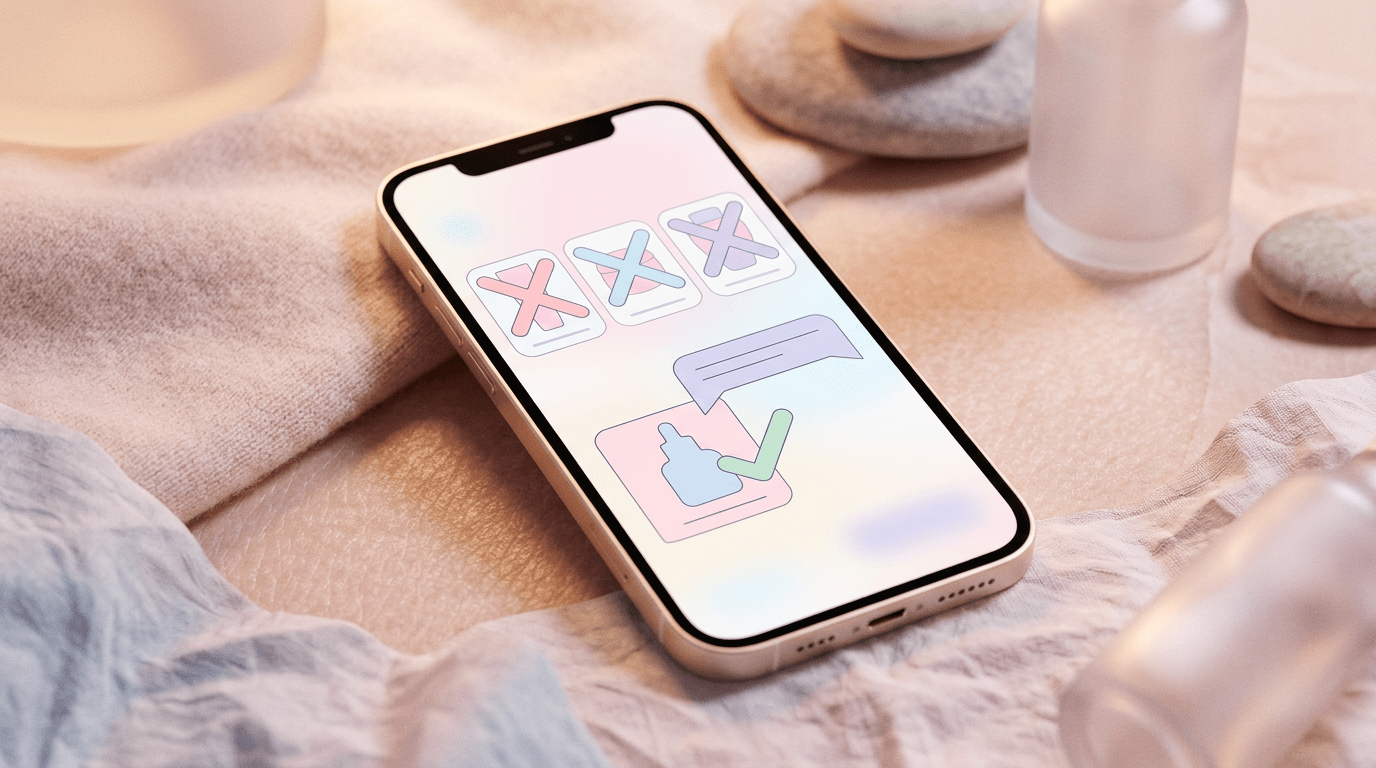
We’ve had our AI sales agent in production since June 2024, across hundreds of thousands of beauty conversations. The conversation below is from a Greek skincare retailer’s live store. It shows what happens when a shopper reveals new information mid-conversation.
Customer: “Good morning, I want a hyaluronic acid serum for deep hydration.”
A clear request that any recommendation engine could match to HA serums.
AI Beauty Advisor: Recommends three hyaluronic acid serums with ingredient details. Then asks: “What skin type do you have? Do you want something more anti-aging or purely hydrating?”
Three options presented, but the conversation doesn’t stop there. It asks qualifying questions to narrow the recommendation further.
Customer: “Which of the three do you recommend best?”
AI Beauty Advisor: Compares all three by use case: one for dry and sensitive skin, one for anti-aging with natural ingredients, one for barrier protection. Again asks: “What skin type do you have?”
No blind recommendation. It pushes for context before committing to a single product.
Customer: “I have dull, dehydrated skin.”
This is the pivot moment. The shopper initially asked for hydration, but dull skin needs brightening, not just moisture.
AI Beauty Advisor: Pivots away from all three HA serums. Based on the retailer’s catalog, recommends a birch sap moisturizing serum rich in natural moisturizing factors: “Hydrates deeply and provides elasticity and radiance to dull, lackluster skin.” Also suggests complementary moisturizers to build a complete routine.
The advisor abandoned its own recommendations. What the shopper asked for and what the shopper actually needed were two different things. No purchase history, no collaborative filter, no “customers also bought” widget would make this pivot. It listened, asked, and adapted based on what the shopper actually said.
What to Look for in a Personalization Solution
After hundreds of thousands of beauty conversations in production, these are the capabilities that separate real personalization from a dressed-up filter.
Does the system ask questions? If it only analyzes clicks and purchases, it is working with incomplete data. Skin type, sensitivities, experience with active ingredients, budget: none of this shows up in browsing behavior. It only comes out through dialogue. Give the system new information mid-conversation and watch what happens. Does it update its recommendations, or stay locked to the original query? Most systems fail this test because they treat the session as a fixed query rather than an evolving one. The transcript above shows what passing looks like.
Two other capabilities matter. One is ingredient awareness. Beauty routines involve multiple products in sequence, and certain ingredients conflict. A system that recommends retinol alongside AHA without flagging the interaction creates returns, not sales. The other is routine building: a shopper asking for a morning routine needs five products in order, not a list of popular items. Budget constraints should affect the output immediately, not get quietly ignored.
Start With One Vertical
You don’t need to overhaul your entire store to test conversational personalization. Start with your most complex product category. That means the one where customers ask the most questions, where returns are highest, and where wrong recommendations cost the most.
In beauty, the most complex categories are skincare and complexion makeup. Ingredient interactions, skin type variations, routine building, and shade matching across brands all create decision complexity that algorithms alone can’t resolve.
We built OmniAdvisor for exactly this problem. Our AI sales agent trains on your actual product catalog and handles the kind of nuanced conversations that drive confident purchases.
Start your free trial or book a demo to see how it works with your products.
Frequently Asked Questions
What is conversational personalization in beauty e-commerce?
It is real-time product matching driven by dialogue, not purchase history. The AI asks about skin type, sensitivities, budget, and routine before recommending anything, then updates those recommendations if the shopper contradicts herself later in the conversation. Setup connects to your product catalog via API, so the agent always reflects your current inventory, not a static snapshot from the last import. Most retailers are live within two weeks without touching their existing store code.
How is an AI beauty advisor different from a recommendation widget?
A widget ranks products by what other customers bought. It has no mechanism to ask questions, which means it cannot capture anything that only comes out in dialogue. Two shoppers both listed as “medium skin tone” will see the same foundation grid, even when one has warm undertones and the other has cool ones. An AI beauty advisor holds the full context of the conversation across every message. In production, conversations typically reach a purchase decision within a handful of messages, and in many of those sessions the final recommendation is a product the shopper never mentioned at the start.
Can an AI beauty advisor handle shade matching and routine building?
Yes, but quality depends on what the AI was trained on. Shade matching requires undertone categories, finish preferences, and coverage levels for each specific product. Routine building requires sequencing logic, because a chemical exfoliant before or after a vitamin C serum is not interchangeable. Agents trained on your catalog handle both. Agents trained on generic knowledge guess.
What results can I expect from conversational personalization?
Among shoppers who engage with the AI, conversion rates are significantly higher than passive browsers. In our production data, activating the agent produces a measurable lift in site-wide conversion rate. The more important number for many retailers is return reduction. Beauty returns on opened products cannot be restocked, so a wrong recommendation has a hard cost per unit. Matching on skin type and sensitivities before the purchase eliminates the most common cause of beauty product returns.
How do I get started with conversational personalization?
Pick one category, not your whole store. Skincare and complexion show the clearest lift because the decision complexity is highest. You do not need to restructure your catalog or retag products. The agent reads your existing product data, including ingredients, descriptions, and variants, directly from your platform. If your catalog data is clean, the main variable is how many edge cases you want to validate before going live: shade matching accuracy, ingredient conflict detection, routine sequencing. Start a free trial or book a demo to see what the agent produces on your actual products.